Did the US Warn Before the Strike? Sailor’s Phone Call Raises Questions
Iranian warship IRIS Dena has been sinked in the Indian Ocean. A sailor called his father before the attack and told him that the US had warned twice, but the commander did not allow the ship to evacuate. 87 sailors were killed in the attack.
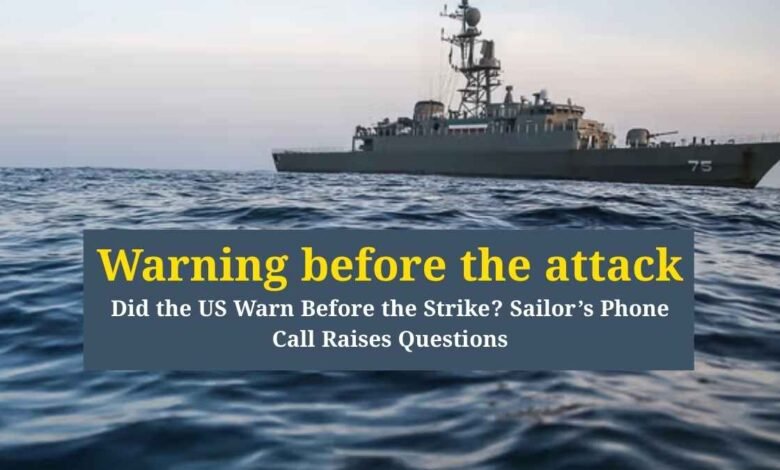
New Delhi/Colombo: A horrific inventory hidden under waves of the Indian Ocean is now coming to the surface. The theory of the US attack on Iranian warship IRIS Dena seems to be completely changing.
While Iran calls it a “sudden attack”, the last phone call of a sailor has brought an “emotional” and “surgical” twist in this development.
Warning before the attack
According to reports, an Iranian sailor contacted his father via satellite phone just before the attack. He said in a tremendous voice that the American submarine had given him a clear warning to leave the ship not once, but twice.
The revelation directly challenges Iranian Foreign Minister Syed Abbas Araghchi’s claim that atrocities were committed in international waters without notice.
Commander vs Crew: Conflict on Deck
Sources said when the ultimatum of evacuation was found by the US military, the ship was shaken. Some sailors had sought permission from the commander to leave the ship, but the commander remained adamant.
Amid the same debate and tension, 19 nautical miles from Sri Lanka’s Gale port, American Torpedo ripped the chest of the IRIS dena.
Bodies lying in the sea
The excursion seen by the Sri Lankan rescue team after Wednesday’s horrific attack was going to shake the soul. So far, 87 bodies have been recovered, while 32 lucky sailors have been rescued. These were the people who resorted to the lifeboat despite the commander’s order.
US Secretary of Defense Pete Hegseth described it as historic for the first time since World War II that submarines have been used to sink an enemy ship.
Diplomatic tensions
Now the battle has come out of the sea and reached embassies. The US has asked the Sri Lankan government not to send rescued Iranian sailors back to Iran. The reason behind this may be to consider these sailors as ‘critical witnesses’ who can open a poll of Iran’s claims.